
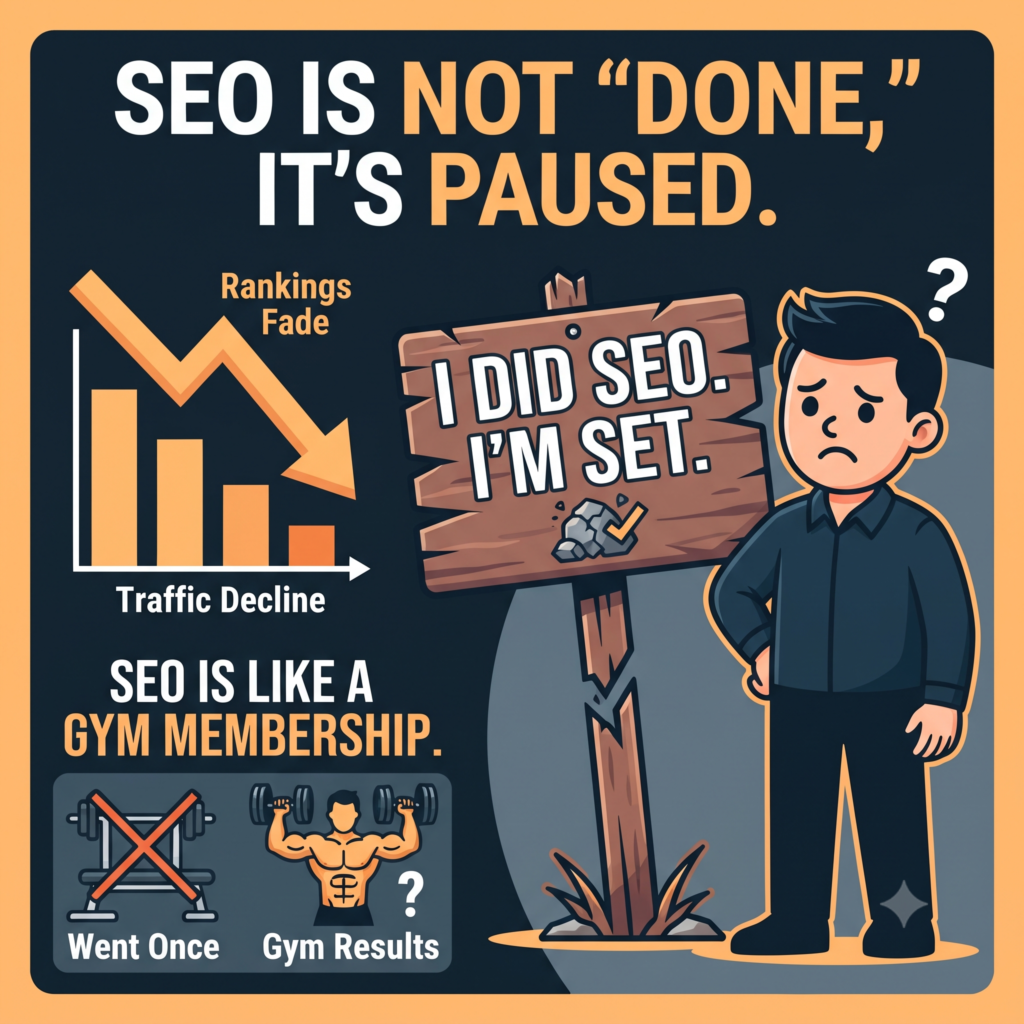
Is SEO a one-time service? No. SEO is not a one-time service — it’s an ongoing process, because Google’s algorithm keeps changing, your competitors keep publishing content and building links, and your own website keeps changing too. A one-time SEO project can get you ranked, but without ongoing work, those rankings usually fade within 6–12 months.
If you’ve ever thought “I already did SEO, I’m set,” this post explains why that’s one of the most expensive misconceptions in small business marketing — and why the businesses that treat SEO as a one-time service almost always lose ground to the ones that don’t.
Why Do Google Rankings Drop After SEO Work Stops?
Rankings drop after SEO work stops for three main reasons:
- Google’s algorithm never stops changing. Google publishes a running log of its search ranking updates, including several major “core updates” every year. A page that ranked well under last year’s rules can lose position under this year’s rules — even if nothing on the page changed.
- Competitors don’t stop working. While your site sits still, other businesses in your market keep publishing new pages, earning new backlinks, and updating their content. Search rankings are relative — if they move forward and you don’t, you fall behind by default.
- Your business changes, but your website doesn’t. New services, new products, new locations. If your site isn’t updated to reflect that, Google has no way of knowing your business grew — and it won’t send you traffic for things you never told it about.
So Is SEO a One-Time Service, or a Long-Term Investment?
It’s not, and treating SEO as a one-time service is the single biggest reason websites lose the rankings they worked hard to earn. SEO is never fully “done” in the way a logo design or a one-off website build is done. It’s closer to a fitness routine than a home renovation:
- A renovation is finished once the work is complete.
- Fitness only works while you keep showing up. Stop training, and the results fade — even though nothing “broke.”
SEO works the same way. A strong SEO push can get your site noticed within a few months. But if nobody is maintaining it afterward, rankings quietly erode. Nothing breaks. No one gets an error message. Traffic just slowly disappears, and most business owners don’t notice until months later, when they check their analytics and wonder what happened.
What Does Ongoing SEO Actually Involve?
Ongoing SEO covers the tasks that keep a website competitive month after month, including:
- Technical monitoring — fixing broken links, slow pages, crawl errors, and structured data issues before they cost you rankings
- Content updates — refreshing old blog posts and service pages with current information, since Google favours recently updated, accurate content
- New content creation — publishing new pages and posts that target keywords you don’t currently rank for
- Backlink building — earning links from other credible websites, which Moz’s ranking factors research lists as one of the strongest signals Google uses
- Performance tracking — reviewing Google Search Console and analytics data monthly to catch drops early and adjust strategy
None of these are one-time tasks. Each one needs to happen on a recurring basis, because the conditions that made your site rank last year won’t be the same conditions next year.
How Long Does It Take for SEO Rankings to Drop Without Maintenance?
Most websites hold their rankings reasonably well for the first 1–3 months after SEO work stops, since search rankings carry some momentum. Between 6–12 months of inactivity, most sites see noticeable ranking erosion — especially for competitive keywords where competitors are actively publishing new content and earning new links. By the 12-month mark, a site that hasn’t been touched typically holds only a fraction of its original rankings.
One-Time SEO vs Ongoing SEO: What’s the Real Difference?
| One-Time SEO | Ongoing SEO | |
|---|---|---|
| Best for | New websites, launches, initial audits | Businesses that want to grow traffic over time |
| Result timeline | A short-term boost, typically fading within a year | Compounding growth as content and links build up |
| What happens if you stop | Rankings plateau, then decline as competitors move ahead | N/A — the work continues |
| Analogy | A single gym session | A gym membership you actually use |
A one-time SEO project isn’t useless — it’s a reasonable way to fix foundational issues or launch a new site. The mistake is treating that one project as the finish line instead of the starting point.
The Bottom Line
If you haven’t touched your website’s SEO in over a year, it’s not “done” — it’s paused. And while it’s paused, your competitors are catching up, or already ahead. Search engine optimization works the same way fitness, savings, and relationships do: consistency compounds, and neglect quietly costs you more than it looks like at first.
Need help figuring out where your SEO actually stands? FastForwardWeb runs SEO audits that show exactly what’s holding your site back — and whether it’s worth fixing with a project or an ongoing plan.
Frequently Asked Questions
Is SEO a one-time payment or a monthly service?
It can be either, depending on your goal. A one-time payment covers a fixed project like a technical audit or initial optimization. A monthly service covers continuous work like content creation, link building, and monitoring — which is what most businesses need to keep growing traffic long-term.
How often should SEO be updated?
Technical checks and performance reviews should happen monthly. Content refreshes on key pages are generally recommended every 6–12 months, or sooner if rankings start slipping.
Can I do SEO myself instead of paying for ongoing service?
Yes, if you have the time to consistently publish content, monitor technical issues, and build backlinks. Most small business owners underestimate the time this takes, which is why they eventually hire it out.